合并K个升序链表 1.题目内容 给你一个链表数组,每个链表都已经按升序排列。
请你将所有链表合并到一个升序链表中,返回合并后的链表。
示例 1:
1
2
3
4
5
6
7
8
9
10
输入:lists = [[1,4,5],[1,3,4],[2,6]] 输出:[1,1,2,3,4,4,5,6] 解释:链表数组如下: [ 1->4->5, 1->3->4, 2->6 ] 将它们合并到一个有序链表中得到。 1->1->2->3->4->4->5->6
示例 2:
示例 3:
提示:
k == lists.length0 <= k <= 10^40 <= lists[i].length <= 500-10^4 <= lists[i][j] <= 10^4lists[i] 按 升序 排列lists[i].length 的总和不超过 10^4
2.解法 (1)顺序合并 思路及算法
我们可以想到一种最朴素的方法:用一个变量 ans 来维护以及合并的链表,第 i 次循环把第 i 个链表和 ans 合并,答案保存到 ans 中。
代码
1 2 3 4 5 6 7 8 9 10 11 12 13 14 15 16 17 18 19 20 21 22 23 24 25 26 //C++ class Solution { public: ListNode* mergeTwoLists(ListNode *a, ListNode *b) { if ((!a) || (!b)) return a ? a : b; ListNode head, *tail = &head, *aPtr = a, *bPtr = b; while (aPtr && bPtr) { if (aPtr->val < bPtr->val) { tail->next = aPtr; aPtr = aPtr->next; } else { tail->next = bPtr; bPtr = bPtr->next; } tail = tail->next; } tail->next = (aPtr ? aPtr : bPtr); return head.next; } ListNode* mergeKLists(vector<ListNode*>& lists) { ListNode *ans = nullptr; for (size_t i = 0; i < lists.size(); ++i) { ans = mergeTwoLists(ans, lists[i]); } return ans; } };
1 2 3 4 5 6 7 8 9 10 11 12 13 14 15 16 17 18 19 20 21 22 23 24 25 26 27 28 29 30 //Java class Solution { public ListNode mergeKLists(ListNode[] lists) { ListNode ans = null; for (int i = 0; i < lists.length; ++i) { ans = mergeTwoLists(ans, lists[i]); } return ans; } public ListNode mergeTwoLists(ListNode a, ListNode b) { if (a == null || b == null) { return a != null ? a : b; } ListNode head = new ListNode(0); ListNode tail = head, aPtr = a, bPtr = b; while (aPtr != null && bPtr != null) { if (aPtr.val < bPtr.val) { tail.next = aPtr; aPtr = aPtr.next; } else { tail.next = bPtr; bPtr = bPtr.next; } tail = tail.next; } tail.next = (aPtr != null ? aPtr : bPtr); return head.next; } }
复杂度分析
时间复杂度:假设每个链表的最长长度是 n。在第一次合并后,ans 的长度为 n;第二次合并后,ans 的长度为 2×n,第 i 次合并后,ans 的长度为 i×n。第 i 次合并的时间代价是 O(n+(i−1)×n)=O(i×n),那么总的时间代价为 O(k^2^n),故渐进时间复杂度为 O(k^2^ n)。
空间复杂度:没有用到与 k 和 n 规模相关的辅助空间,故渐进空间复杂度为 O(1)。
(2)分治合并 思路及算法
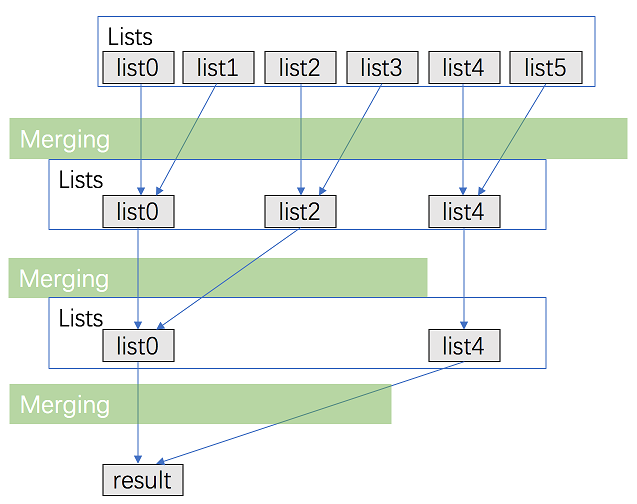
考虑优化方法一,用分治的方法进行合并。
将 k 个链表配对并将同一对中的链表合并;
第一轮合并以后, k 个链表被合并成了 $\frac{k}{2} $个链表,平均长度为 $\frac{2n}{k}
重复这一过程,直到我们得到了最终的有序链表。
代码
1 2 3 4 5 6 7 8 9 10 11 12 13 14 15 16 17 18 19 20 21 22 23 24 25 26 27 28 29 //C++ class Solution { public: ListNode* mergeTwoLists(ListNode *a, ListNode *b) { if ((!a) || (!b)) return a ? a : b; ListNode head, *tail = &head, *aPtr = a, *bPtr = b; while (aPtr && bPtr) { if (aPtr->val < bPtr->val) { tail->next = aPtr; aPtr = aPtr->next; } else { tail->next = bPtr; bPtr = bPtr->next; } tail = tail->next; } tail->next = (aPtr ? aPtr : bPtr); return head.next; } ListNode* merge(vector <ListNode*> &lists, int l, int r) { if (l == r) return lists[l]; if (l > r) return nullptr; int mid = (l + r) >> 1; return mergeTwoLists(merge(lists, l, mid), merge(lists, mid + 1, r)); } ListNode* mergeKLists(vector<ListNode*>& lists) { return merge(lists, 0, lists.size() - 1); } };
1 2 3 4 5 6 7 8 9 10 11 12 13 14 15 16 17 18 19 20 21 22 23 24 25 26 27 28 29 30 31 32 33 34 35 36 37 //Java class Solution { public ListNode mergeKLists(ListNode[] lists) { return merge(lists, 0, lists.length - 1); } public ListNode merge(ListNode[] lists, int l, int r) { if (l == r) { return lists[l]; } if (l > r) { return null; } int mid = (l + r) >> 1; return mergeTwoLists(merge(lists, l, mid), merge(lists, mid + 1, r)); } public ListNode mergeTwoLists(ListNode a, ListNode b) { if (a == null || b == null) { return a != null ? a : b; } ListNode head = new ListNode(0); ListNode tail = head, aPtr = a, bPtr = b; while (aPtr != null && bPtr != null) { if (aPtr.val < bPtr.val) { tail.next = aPtr; aPtr = aPtr.next; } else { tail.next = bPtr; bPtr = bPtr.next; } tail = tail.next; } tail.next = (aPtr != null ? aPtr : bPtr); return head.next; } }
复杂度分析
时间复杂度:考虑递归「向上回升」的过程——第一轮合并 $\frac{k}{2} $组链表,每一组的时间代价是 O(2n);第二轮合并 $\frac{k}{4} $ 组链表,每一组的时间代价是 O(4n)……所以总的时间代价是 O(kn×logk),故渐进时间复杂度为 O(kn×logk)。
空间复杂度:递归会使用到 O(logk) 空间代价的栈空间。